

(Dortmund, Germany) – Thyssenkrupp Nucera AG & Co. KGaA, based in Dortmund, has halted its planned construction of a series production facility for its high-temperature electrolysis cell (Solid Oxide Electrolysis Cell, SOEC). The company stated that the investment does not offer an economically attractive business model "under the current conditions." The decision was made "after careful strategic evaluation of market maturity, investment requirements, and economic prospects."
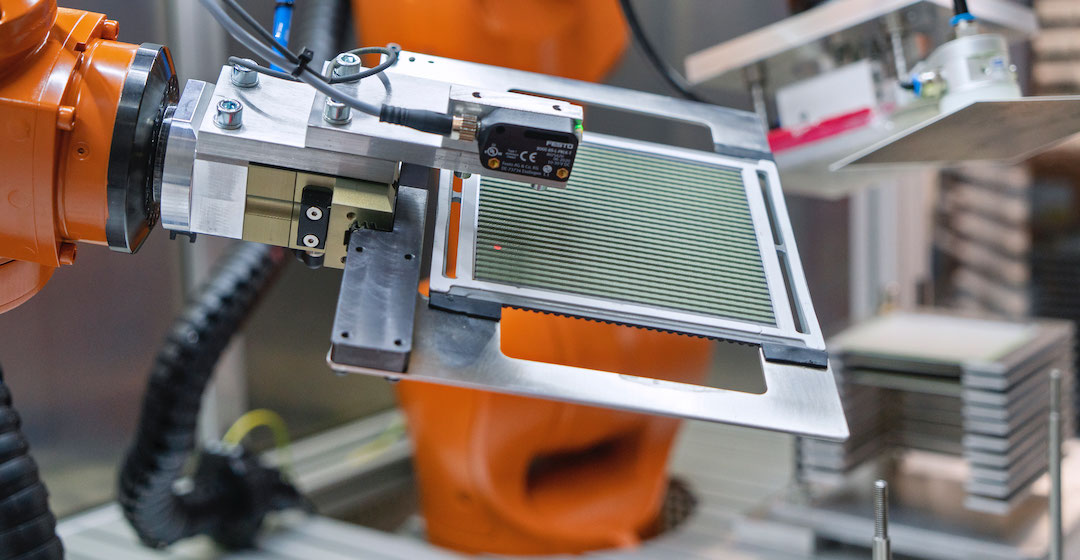
Fully automatic assembly of individual components into high-temperature electrolyzers and high-temperature fuel cells. © Fraunhofer IKTS
The plan was to establish series production for hydrogen technology. The Arnstadt site in Thuringia seemed almost certain to be chosen. Thyssenkrupp Nucera, in cooperation with the Fraunhofer Institute for Ceramic Technologies and Systems (IKTS), has been operating a pilot production facility there since May 2025 for high-temperature stacks with a capacity of eight megawatts ( more information here ). The institute had developed the foundations for the SOEC technology. Series production was planned to begin in 2029.
“The delayed ramp-up, particularly in high-temperature electrolysis, and the associated uncertain investment conditions for project developers have significantly impacted expected demand and thus altered the economic prospects for commercialization on the originally planned scale.” Thyssenkrupp Nucera will “focus in the future on the chlor-alkali business, industrially available alkaline water electrolysis (AWE), and soon, high-pressure water electrolysis.”
As recently as January, there was €900.000 in funding.
The closure of the Arnstadt plant was announced rather casually by the company in its report for the third quarter of fiscal year 2025/2026, which ended on July 31. According to information from Mitteldeutscher Rundfunk ( MDR), the company had received €900.000 in funding from the Thuringian Ministry of Economic Affairs just over six months earlier, in January of this year. At the end of 2024, Thyssenkrupp Nucera was even able to celebrate receiving €36 million in EU funding for the construction of the 300-megawatt production facility, a development that was announced at the time with great fanfare and numerous declarations of intent ( more on this here ).
Comment : One is almost tempted to say: a classic case. Once again, a corporation pockets taxpayers' money, causing the public sector significant bureaucratic effort and administrative costs, only to ultimately discover that the funds weren't needed at all because the plan wasn't implemented. The steel company ArcelorMittal SA did something similar two years ago in Bremen and Brandenburg, to name just one more example ( more on that here ). While the government continues to cut state aid for the most vulnerable members of society, the wealthiest can collect what amounts to unconditional basic incomes because the funds aren't tied to any long-term success. Funding providers must finally hold companies accountable for such failures. Perhaps then these cases will decrease, cases where one is almost tempted to believe that taking money is part of the business model – and not solely due to the management's planning failures. Andreas Lohse, Editor-in-Chief
Photo above
Thyssenkrupp Nucera AG, based in Dortmund, received subsidies for a project in Arnstadt that has now been cancelled. © Thyssenkrupp Nucera AG & Co. KGaA



